Vedeta Antenei 1, Daniela Crudu, a fost prezenta in acest weekend la Craiova pentru o prezentare de moda, ocazie cu care i-a fermecat pe olteni, asa incat a fost ceruta si de sotie.
Craiovenii care au umplut sambata pana la refuz sala Teatrului Liric au putut admira tinutele nonconformiste prezentate in premiera de designerul Stefan Musca, dar si formele frumoasei asistente de la matinalul cu Razvan si Dani.
Admiratorii insa nu s-au limitat la a-i trimite numai flori brunetei focoase, ci unul dintre ei a cerut-o chiar de nevasta, scrie
Cancan.
"Daniela Crudu are cei mai frumosi sani din Romania. Cand a urcat pe scena, m-a fermecat. Am cerut-o de sotie pentru ca in clipa de fata este idolul meu, iar sanii ei sunt perfecti, ii admir in fiecare dimineata, la emisiune", a declarat craioveanul, care a spus ca nu mai doarme noptile de dorul ei.
Tuesday, May 19, 2009
Daniela Crudu a fost ceruta de nevasta
Thursday, May 7, 2009
The Girl Fair of Mount Gaina

Wednesday, May 6, 2009
Romania Church Starts Bribery Probe
BalkanInsight.com
The Archbishop of Tomis, in eastern Romania, has launched an internal investigation following media reports that high-ranking officials from the Orthodox Church allegedly asked for money in order to illegally facilitate the enrollment of a journalist at a church school.
The daily newspaper Romania Libera on Tuesday published an undercover investigation, documenting how Archbishop Teodosie allegedly asked for money and other material advantages in exchange for his help. A journalist from the newspaper apparently bribed the Archbishop in order to be enrolled at the Teology University in Constanta, eastern Romania, not having the necessary studies required to attend the university.
"We have started an internal inquiry to check out if media allegations are true", a church spokesperson said.
Around 85 per cent of the population in Romania belong to the Orthodox Church and the Church remains the most trusted public institutions, according to polls.
But the Orthodox Church has often been marred by allegations of corruption and nepotism. After the fall of communism, the Church has never admitted that it cooperated with the regime, though some bishops have admitted to collaborating.
Alarm at EU passports for Moldova
The EU will this week launch talks with six Eastern European neighbours on closer relations - including Moldova, which only last month was rocked by violence following a disputed election.
Moldova is Europe's most impoverished country and its 4.1 million people can only travel to the EU if they have a special visa. But Romania has offered passports to up to one million Moldovans - alarming both Moldova and some in the EU, says the BBC's Oana Lungescu.
Step into the ornate building of the central post office in the Moldovan capital, Chisinau, and you see small crowds of people huddling around a big marble-topped table.Each one is filling out an application for Romanian citizenship. Dozens more queue up to get the forms; others wait in line to post them to the Romanian embassy.
"It's because we haven't got work here," one woman says. "We want to look for work in Romania or Europe. With a Romanian passport it's going to be easier."A young man in the queue says a Romanian passport is "a chance to see the world".
"I want to raise my family in Moldova, but I also want to travel, meet new people," he adds. "This is my future."
Law changes
Around 1,000 people a day have come to the post office in the past few weeks, since Romania changed its citizenship law to speed up procedures for Moldovans, following the violent anti-government riots that erupted in the former Soviet republic last month after a disputed election.
The change was initiated by President Traian Basescu in an unusual tit-for-tat move after his Moldovan counterpart, Vladimir Voronin, accused Romania of backing the protesters, expelled its ambassador and re-introduced visa requirements for Romanians.
Mr Basescu said he could not allow "a new Iron Curtain" to descend on the border with Moldova, most of which was part of Romania until it was annexed by the Soviet Union in 1940.
The decision may be political bluster ahead of Romania's presidential election later this year, but some commentators said Mr Basescu was trying to leave Mr Voronin "without people".
The changes are clear enough.
The language test has been scrapped, as Moldovan is practically the same as Romanian anyway. Anyone with a great-grandparent who was once a Romanian national can apply and expect an answer within five months.
Until now, only a few thousand requests were approved every year - so envelopes have been piling up at the Romanian embassy in Chisinau.
Speaking on Romanian TV, President Basescu said there were 650,000 envelopes, but some enclosed several applications.
He estimated the number of those who wanted to become Romanian citizens at up to one million, a quarter of Moldova's population.
'Common history'
Outside the embassy, there is hope, uncertainty - more people waiting in line.
Nadia Codreanu, an accountant, sent her request in 2002.
"I really hope it will be easier, and that in half a year I will get the Romanian passport," she says.
"Moldovans feel Romanian because you can't just forget many centuries of common history and say we have nothing in common with Romania".What she does with her passport will depend on what happens in Moldova.If the authorities increase pressure on the pro-Western opposition, Nadia explains, she may leave the country.
More than 100,000 Moldovans hold Romanian passports, but even more are believed to have Russian citizenship, especially in Moldova's breakaway region of Trans-Dniester, which enjoys Moscow's backing.Despite almost two decades of independence, Moldovans still appear divided about who they are and whether their country should get closer to Russia or the West as it grapples with a deepening economic and social crisis.
For Vladimir Turcanu, an MP from the ruling Communist Party, it is not a question of identity, but of outside intervention.
"This mass granting of the Romanian citizenship is a way to assimilate the Republic of Moldova," he says.
"We see it a threat to the statehood, a threat to the integrity and sovereignty of our country."
'Destabilising'
Under EU laws, Romania is entitled to give citizenship to anybody it likes, just as Spain granted legal papers a few years ago to 600,000 irregular migrants.
Spain also allowed citizenship applications for up to 500,000 descendents of people who went into exile after its civil war.
But it is Romania's move that has triggered most concern.
Senior EU diplomats call it unwise, risky and destabilising.
Amid fears that up to a million impoverished migrants could enter Europe through the back door, Romanian Foreign Minister Cristian Diaconescu reassured other EU members on Friday that decisions would be taken on a case-by-case basis and that many people would not qualify.
Romanian diplomats say only 20,000 cases are in the pipeline, because many Moldovans have failed to complete the complex application procedures.
Whatever the figures turn out to be, there is a clear risk that Moldova, already weakened by the conflict in Trans-Dniester and an economy on the brink, could become a chronic source of instability on Europe's eastern border.
Unparalleled exodus
The EU envoy for Moldova, Kalman Mizsei, thinks the real answer would be to allow all Moldovans to travel to the EU without a visa.
"Moldova's situation," he says, "differs from any other and therefore we, the European Union, also need to have bold initiatives here that would give the perspective of a visa-free situation for the Moldovans.""That's an issue of core importance for Moldova as a state."
It is not a call that EU interior ministers want to hear.
Germany and others say Moldova has little prospect of visa-free travel for the next three to five years.
But one million Moldovans have already left, often without legal papers, in search of work and a better future. It is an unparalleled exodus.In Chisinau's bustling market, an old woman selling a few bunches of parsley told me that all seven of her children had left to work in Romania, Italy and Russia.
It is a story you hear across the country. For with or without Romanian passports, Moldovans are choosing to vote with their feet.
Story from BBC NEWS
Tuesday, May 5, 2009
Catrinel Menghia
Corvinilor Castle
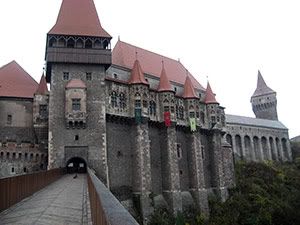
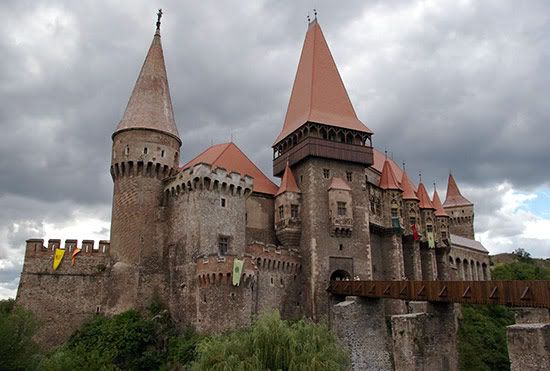
Built in the 14th century, Corvinilor Castle represents one of the most amazing and well-preserved medieval buildings, being in fact the most famous property of Iancu de Hunedoara, building that even today dominates the city of Hunedoara.
Iancu de Hunedoara was the one who stopped the Turkish army at Belgrad in their rise towards Europe, after conquering the Constantinople in 1456. Only a few know that even today the bells of the Catholic Churches still toll in the middle of the day for this victory, as a decision of the Vatican Church.
The Corvinilor Castle is one piece of a kind because of the special styles in which it was built and because of the presence of some military innovations. It is also known that people led a very impetuous life there at the castle for more than 400 years. This building suffered along the years various changes and during Iancu de Hunedoara’s reign, the castle became also a luxurious home, not only a strategic point.
The castle has 42 chambers, 2 platforms, 2 bridges and is built on an area of 7000 square m.
The access to the castle is made on a wooden bridge which is sustained by 4 massive stony piers that are placed in the riverbed of Zlasti, leaving behind the Hussan’s Court and the niche that shelters the statue of St. John de Nepomuk, the protector of bridges. From there you can see the new rectangular-shaped stony tower (Turnul nou de poarta) which is impressive by its great size. You can also visit the prison of the castle where Vlad Tepes was supposed to have been kept as prisoner. On the left side, just as you get out of the stony tower, you can see Loggia Matia at whose floor one can see the only secular fresco dating the Renaissance and also The Golden Chamber where one can see “Items of the collection of the museum from the Corvinilor Castle”. At first, the museum exhibitions focused only on the Middle Ages items, but in short time, these approached other fields, such as archaeology, ethnography, decorative art and ancient books.
At the first level of the New Gate Tower, you can find the “Princesses’ Living Room” (Camera Domnitelor) where you can see pieces of furniture belonging to the 19th century: a table, a sideboard and a cupboard. Across the spiral staircase, one reaches the Council Hall (Sala Dietei), which is built in late gothic style. At the exit, the staircase leads to the floor where the Capistrano Tower is situated. To the right there is another staircase that leads to the second level of the Southern Palace, to the rooms that were used in the 18th century as offices for the iron mines Administration of Poiana Rusca Mountains.
In the yard, near the well, one can also visit the artillery platform, which was neatly rearranged in the 19th century. From there you have a pleasant view over the Bears’ Pit, the Northern Palace, the chapel and the courtyard of fountain.
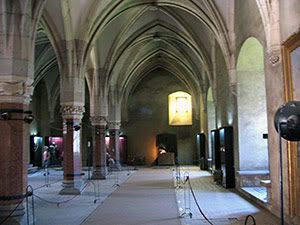
The last sight, the Knights Hall (Sala Cavalerilor), one of the most interesting laic spaces in 15th century Transylvania, is situated in the Western side of the castle, at the ground floor of the Great Palace. It is divided into two sectors by a row of octagonal columns. This hall served as dinning room for festive occasions or as judgment and council room for noblemen, after the German model.
“You have water, but you have no soul”
In the vicinity of the entrance of the church, there is a fountain which was dug in stone by three Turkish prisoners. The legend says that when these three prisoners were captured by Iancu de Hunedoara from his battles against the Turkish army, they were told that if they dug in stone and reached for water, they would be released. For ten years the Turkish prisoners dug nearly 20-25 meters into stone and they finally reached for water, but instead of being released, they were beheaded. This is just a legend and it’s not specific only to Corvinilor Castle. Before being executed, it is said that one of the prisoners had carved into stone the following words: “You have water, but you have no soul”. The truth is that one of the prisoners, which was in fact the son of a vizier, carved on one of the stones from the wall near the well that he built that well together with two other prisoners while they were prisoners to these giaours.

Saturday, May 2, 2009
The most “precious” museum of Romania
At the end of the 19th century, few engineers and miners that were working at the mines around Brad (in the Apuseni Mountains) have gathered some interesting mine rocks in order to display them the beauties of the hidden depths of the land.
This was how the Gold Museum came into existence, more than one century ago. At the beginning, the museum hosted only gold exhibits from the surrounding area. Since then due to donations and exchanges, the patrimony of the museum has gained pieces from other parts of the country and the entire world.
Now, the museum exhibits over 2500 samples of minerals, 1000 of which are gold. From the special specimens the light green fluorite octahedron of Cavnic, diamonds from South Africa, pyrite cubic crystals are quite remarkable. However, the main attraction consists in the native gold samples, of different forms and shapes.
At the same time, the museum has a nice mineral collection, ranging from diamond to amber, jasper and agate, sapphire, topaz, emeralds. Here you will also see minerals as they were discovered in Romania for the first time: sylvinite, tellurium, andorit, monsemit. An interesting section of the museum presents the mining history of the area. There are stone hammers over 5000 years old, and a miner hat dating from the 19th century made of cloth impregnated with animal fat. Here you can see the “saidroc”, the tool used in the past to separate gold-bearing sand from water. At Stănija – a nearby village – even today there are peasants gathering gold with the “saidroc”, ( just for fun).
It is worth mentioning that there are only two gold museums in the world, on nearly opposite sides of the globe, united by their fascination of this noble metal: one is in Bogota, the capital of Columbia, and the other is here, in Romania.
Thursday, April 30, 2009
Adrian Nastase

Leonard Doroftei

Leonard Doroftei (full name Leonard Dorin Doroftei) was born on April 10, 1970 in Ploiesti, Romania. He is a famous Romanian boxer.
Biography and Career :
Discovered by the emeritus coach Titi "Towel" Tudor, Doroftei began boxing in 1884, aged 14 for the club Prahova from his hometown.
His career continued at Steaua Boxing Club then at Freedom Star Club Constanta. Throughout shi career he has been coached by great names like Emil Popa, Ilie Dascalu, Relu Auras.
Doroftei scored his first successes in the junior league thanks to his powerful left hand strike. He became national champion in 1986 and 1987.
The successes in the junior league were followed by five titles in the senior league in 1992, 1993, 1994, 1996 and 1997.
His most notorious winnings were in the int ernational tournaments. He won the world Champion title in Berlin 1995. After the second place at the European Championship in Bursa 1993, he obtained the title of European champion in 1996 at Vejle.
His performances at the Olympic games in Barcelona 1992 and Atlanta 1996, where he obtained the bronze medals , where among the best ever in Romanian boxing history.
In 1998, after 13 years and over 250 amateur boxing, Leonard "The Lion" Doroftei goes into the pro league.
In 6 years of professional boxing he boxed for the Canadian club Interbox from Montreal, coached by Stephane Larouche.
He disputed 24 matches, winning 22 of them, 8 of whom by K.O , loosing one game and one draw.
His most important fights were held stating from 2002. In that year, on the 5th of January in San Antonio USA, he claims the World Title Light Weight WBA version from Raul Balbi. On the 31st of may he thrilled an audience of more than 8.000 in Bucharest’s boxing hall "Ioan Knust Ghemanescu" by winning the rematch against Raul Balbi.
On the 17th of May 2003 he boxes in Pittsburg USA for the unification of the WBA and IBF titles against the American Paul Spadafora, the match ending in a draw. Leonard remains in the possession of the WBA belt.
On October 23rd 2003 in Bucharest he looses the world title without throwing a single punch because he didn't make the weight limit. He was 4¼ lb (1.9 kg) over the 135 lb (61.2 kg) weight limit, so he lost his WBA title in favor of Miguel Calist.
On July 25, 2004 he tried to win the interim WBC title but Arthuro Gatti knocks him out in two rounds.
Trivia :
- He is married and lives in Romania with his wife and two sons.
- He works as a trainer for boxing prospects.
Awards :
- Champion WBA version.
- 239 winnings in the amateurs league.
- European Champion Vejle 1996.
- World Champion in Berlin 1995.
- Bronze medals at the Olympic games in Barcelona 1992 and Atlanta 1996.
Tuesday, April 28, 2009
DISCOVER ROMANIA AS A TRAVEL DESTINATION
Romania, a name which in many minds is synonymous with many bad things. This, because nobody told you the good things about Romania. Nobody told you for exemple, that Romania is a country inhabitated by 600.000 years, and the ancestors of the romanians, had a blossom and high civilization the same at least, as the greeks and romans, and some ancient gods, for exemple Orfeus was tooked by the greeks from here, the same with Herodot which borrowed from the dacian doctors-priests the otah which today is named after him. Just a few people known that the jet engine, the fountain pen or the insulin was romanian inventions, or that the old writing from the world was discovered on the valley of the river Mures from Romania from where the Summerian civilizations just barrow it. These are things which can be learn from the magazines or internet, but nobody and nothing will offer you the sensation that you will live coming in these country blessed by God. Here you will find all the relief forms existing in nature: plain, hill, plateau, mountains and sea. All the tourists which are coming in Romania, and visit this country, are surprised by the diversity of the relief and its alternancy because here the hills are plaiting harmonious and naturally with the plain and the mountains. Here, the fall on the valleys of the Carpathians Mountains, the colours of the forrest made a charming immage that never will erase from your mind. Do not forget the faboulous Danube Delta, natural reserve of biosfera and a paradise of birds and fishes. The hay stacks, nature allways green, herds of cattle and especial the flock of sheeps, which sometime cross over the roads,giving to the tourists the ocasion to see the ancient tradition of transhumance will enjoy your eyes and feelings help you to remember the period of your childhood or will make you to see alive the stories of your grandparents. If you will climb on the pick of the mountains you will find there as in to the plains or in to the hills region, beautiful landscapes, glacial lakes cleans and clears as some eyes used by the planet to watch the sky. You will be impressed by the silence and the fresh and unpolutted air, and in the winter season you will be able to skiing in to the ski resort which are spread in all Romania. All this form the nature of the country but are not the only one things which can be seeing here. The tracks of the past are present at every step that we make in this country. The fortifications situated on the picks of the hills as some vultures nests, the palaces of the nobiles, the summer residence of the romanian royal family from Peles, the fortified churches from Transylvania which are the romanian equivalent of the castles from Loira valley (France), the painted churches from Moldova(Bucovina), the faimous constructions and wooden churches from Maramures, the medieval towns-citadells Brasov, Sighisoara, Sibiu, Cluj-Napoca, Alba Iulia, Hunedoara, are so many living proofs of the existence on these lands to a lineage which not just defended the european civilisation alone, but had time between to invasions of the empires from neighbourhood to create and let to its progenys and to humanity real treasures of architecture and art. As a proof of their value and apreciations many of this vestiges was included in to the UNESCO heritage. You will be glad to discover the romanian traditions very well preserved yet in some regions and the numerous legends of the place the most well known beiing the one of the Count Dracula. And when you are tired to visit all the places that I've described to you above, you will be able to stop to clean and peaceful hotels or in guest houses which preserved and unchanged the way of life of the Romanian peasant. You will be able to feast from our traditional dishes which are so tasty then I can't find the right word to describe it and you will drink from our wine or plum brandy which will fill the taste of food. Which is very important ot know is that, in Romania over 80% from the traditional food is prepared using natural ingredients, obtained from bio traditional methods. Because of that the taste of our dishes and liquers or wines is different by the one from the rest of Europe and you will find in it the flavour and the savour of the earth which was help to grow the vegetals, the fruits, the grass, the flowers or the cereals which feed the animals from whose meet, milk or honey you eat. At the end of the day you will walk trough our cities or villages without the fear to be robbed or killed. Romania is a safe country and the criminality from our localities is below that the one from the biggest citys of the world. In the night time you will have a sweet sleep, without worries as in your childhood, in the silence of the romanian nights, because the next day to go again on your way trough that wonderfull country, discovering its treasures and pray the Lord that your trip never ends.
This is the real Romania.
Monday, April 27, 2009
Gigi Becali

In an opinion piece written after Becali's inflammatory declaration, journalist Radu Călin Cristea quoted Cristian Pârvulescu, a Romanian political analyst, who described Becali as a "populist who practices a superficial form of legionarism", referring to the fascist Iron Guard movement which took place in 1930s Romania and whose members were named "legionnaires" (legionari). Cristea also warned that society and the political class should stop regarding Becali as an "inoffensive and amusing clown".
Ionut Iftimoaie


Sunday, April 26, 2009
Bistriţa


The earliest indication of settlement in the area of Bistriţa is from Neolithic remains. Pechenegs settled the area in 12th century due to attack from Cumans and were given name of Beszterce's district as Besenyő (Hungarian of them) which was centered by Beszterce. Transylvanian Saxons settled the area in 1206 and dubbed the region "Nosnerland". The destruction of Markt Nosa ("Market Nösen") by M0ngols heading toward Central Europe was described by a document from 1241. Being situated on several Trade routes, Bistriţa became a flourishing Medieval trading post. The town was named after the Bistriţa River, whose name comes from the Slavic word, bystrica meaning "the limpid water".
Bistriţa became a Free royal town in 1330. In 1353 it gained the right to organize an annual 15-day fair, as well as a seal containing the coat of arms of an ostrich with a horseshoe in its beak. In 1465, the city's fortifications had 18 defensive towers and bastions defended by the local guilds. It was also defended by a Kirchenburg, or fortified church.
It became part of Romania after 1919, except during its reversion to Hungary between 1940 and 1944.
The Bistriţa-Năsăud County Museum, located in a former barracks, contains Thracian, Celtic, and German artifacts. 19th century fires destroyed much of the city's medieval citadel.


Andreea Marin


Biography and Career :
Andreea Marin attended the local High-School from Roman and after that she continued her studies at Iasi University from Romania. She got specialized in journalism and public relations at "Thompson Dundation" and in United States at The University from South Carolina.Andreea Marin gathered a huge professional experience during her colaboration with TVR 1 so that she was included in the Top 50 of the most successful women in Romania made by Capital Magazine.Andreea Marin is also the programme director for "The Prime Time World Broadcast", an international company from Madrid, Spain.Andreea Marin is famous due to her TV Show named "Surprize, Surprize" started in 1998.
Andreea Marin made several documentaries and took interviews to a lot of famous international personalities including : Harrison Ford, Liam Neeson, Mike Meyers, Erik Roberts, Martin Landau, Larry Hangman, Richard Clayderman, Martin Lawrence, Beyonce, Liza Minnelli and many more.Andreea Marin was the presenter for many musical awards like: - Eurovision, Mamaia, Cerbul de Aur.
She represents the Romanian Image for : - Garnier - L'Oreal;- BMW Automobiles;- Procter and Gamble - Head & Shoulders;- Cartier (jewels and stuff).Statistics reports show that more than 879,000 romanians are watching "Surprize, Surprize" weekly, having the highest rate of audience.
Quotes :- I can change the way I look, the way I live and my career because I am extremly flexible and I have a strong motivation;- If I fall, I rise up again on my knees and start building all the things better.
Trivia :-
In 2006 she married Stefan Banica Jr. ;
- She is the first Romanian journalist who climbed Kilimanjaro;
- Her TV Show "Surprize, Surprize" has been nominated for "The Best Social TV Show", every 5 years.
Filmography :
1. The Eurovision Song Contest (2004) (TV) .... Romanian vote presenter
2. The Eurovision Song Contest (2000) (TV) .... Romanian vote presenter


Monica Columbeanu


Mircea Eliade (1907-1986)

Eliade was educated as a philosopher. He published extensively in the history of religions and acted as editor-in-chief of Macmillan's Encyclopedia of Religion. The influence of his thought, through these works and through thirty years as director of History of Religions department at the University of Chicago, is considerable.
Eliade's analysis of religion assumes the existence of "the sacred" as the object of worship of religious humanity. It appears as the source of power, significance, and value. Humanity apprehends "hierophanies"--physical manifestations or revelations of the sacred--often, but not only, in the form of symbols, myths, and ritual. Any phenomenal entity is a potential hierophany and can give access to non-historical time: what Eliade calls illud tempus (Latin for 'that time,' I tend to think of it as 'yon time'). The apprehension of this sacred time is a constitutive feature of the religious aspect of humanity.
Mircea Eliade was born in Bucharest, Romania on 13 March 1907. Although Romanian records give his date of birth as 28 February, this is according to the Julian calendar, since the Gregorian calendar was not adopted in Romania until 1924. Eliade’s Orthodox Christian family celebrated his birthday on the Day of the Forty Martyrs, which is 9 March by the Julian calendar, and Eliade himself gave that date as his birthday. Despite a childhood interest in entomology and botany (which doubtless first attracted his attention to Goethe, a lifelong role model and inspiration), he developed an interest in world literature and was led from there to philology, philosophy, and comparative religion. As a youth he read extensively in Romanian, French, and German, and around 1924-25 he learned Italian and English to read Raffaele Pettazzoni and James George Frazer in the original.
In 1925 Eliade enrolled at the University of Bucharest where he studied in the department of philosophy. The influence of Nae Ionescu (b.1890), then an assistant professor of logic and metaphysics and an active journalist, was keenly felt by the young Eliade and the shadow which fell on the older scholar because of his involvement with the extreme right in inter-war Romania has darkened Eliade's reputation.
Eliade's Master's thesis examined Italian Renaissance Philosophers from Marcilio Ficino to Giordano Bruno, and Renaissance Humanism was one of his major influences when he turned to India in order to "universalize" the "provincial" philosophy he had inherited from his European education. Finding that the Maharaja of Kassimbazar sponsored European scholars to study in India Eliade applied and was granted an allowance for four years. In 1928 he sailed for Calcutta to study Sanskrit and philosophy under Surendranath Dasgupta (1885-1952), a Cambridge educated Bengali, professor at the University of Calcutta, and author of a 5 volume, History of Indian Philosophy (Motilal Banarsidass 1922-55).
He returned to Bucharest in 1932 and successfully submitted his analysis of Yoga as his doctoral thesis at the Philosophy department in 1933. Published in French as Yoga: Essai sur les origines de la mystique Indienne this was extensively revised and republished as Yoga, Immortality, and Freedom. As Ionescu's assistant Eliade lectured on, among other things, Aristotle's Metaphysics and Nicholas of Cusa's Docta Ignorantia. From 1933 to 1939 he was active with the Criterion group who gave public seminars on wide-ranging topics. They were strongly influenced by the philosophy of "trairism," the search for the "authentic" in and through lived experience (Romanian, traire) seen as the only source of "authenticity."
After the Second World War, during which he served with the Romanian Legation in the UK and Portugal, Eliade was unable to return to the newly communist Romania because of his connection with the right-wing Ionescu. In 1945 he moved to Paris where his acquaintance with George Dumézil, an important scholar of comparative mythology, secured a part-time post for him at the École des Hautes Études at the Sorbonne teaching comparative religion. From this time on almost all of Eliade's scholarly works were written in French.
At the prompting of Joachim Wach, Eliade's predecessor at the University of Chicago, a comparativist and hermeneuticist, Eliade was invited to give the 1956 Haskell Lectures on "Patterns of Initiation" at the University of Chicago. These were later published as Birth and Rebirth. In 1958 he was invited to assume the chair of the History of Religions department in Chicago. There he stayed until his death on 22 April 1986, publishing extensively and writing largely unpublished fiction. He also launched the journals History of Religions and The Journal of Religion and acted as editor-in-chief for Macmillan's Encyclopedia of Religion.
Despite his focus on the history of religions, Eliade never relinquished his philosophical agenda. That said, he never fully clarified his philosophy. There has been radical disagreement over his thought, some seeing it as a crucial contribution to the study of religion, and some seeing him as an obscurantist whose normative assumptions are unacceptable.
In Cosmos and History:The Myth of the Eternal Return (1954), a book which he was tempted to subtitle Introduction to a Philosophy of History, Eliade distinguishes between religious and non-religious humanity on the basis of the perception of time as heterogenous and homogenous respectively. This distinction will be immediately familiar to students of Henri Bergson as an element of that philosopher's analysis of time and space. Eliade contends that the perception of time as an homogenous, linear, and unrepeatable medium is a peculiarity of modern and non-religious humanity. Archaic or religious humanity (homo religiosus), in comparison, perceives time as heterogenous; that is, as divided between profane time (linear), and sacred time (cyclical and reactualizable). By means of myths and rituals which give access to this sacred time religious humanity protects itself against the 'terror of history', a condition of helplessness before the absolute data of historical time, a form of existential anxiety.
In the very process of establishing this distinction, however, Eliade undermines it, insisting that non-religious humanity in any pure sense is a very rare phenomenon. Myth and illud tempus are still operative, albeit concealed, in the world of modern humanity and Eliade clearly regards the attempt to restrict real time to linear historical time as finally self-contradictory. He squarely sets himself against the historicism of Hegel.
"The sacred" has also been the subject of considerable contention. Some have seen Eliade's "sacred" as simply corresponding to a conventional concept of deity, or to Rudolf Otto's ganz andere (the "wholly other"), whereas others have seen a closer resemblance to Emile Durkheim's socially influenced sacred. Eliade himself repeatedly identifies the sacred as the real, yet he states clearly that "the sacred is a structure of human consciousness" (1969 i; 1978, xiii). This would argue more for the latter interpretation: a social construction of both the sacred and of reality. Yet the sacred is identified as the source of significance, meaning, power and being, and its manifestations as hierophanies, cratophanies, or ontophanies accordingly (appearances of the holy, of power, or of being). Corresponding to the suggested ambiguity of the sacred itself is the ambiguity of its manifestations.
Eliade does state that believers for whom the hierophany is a revelation of the sacred must be prepared by their experience, including their traditional religious background, before they can apprehend it. To others the sacred tree, for example, remains simply a tree. It is an indispensable element of Eliade's analysis that any phenomenal entity could be apprehended as an hierophany with the appropriate preparation. The conclusion must be that all beings reveal, and at the same time conceal, the nature of Being. A reprise of Nicholas of Cusa's Coincidentia Oppositorum is evident here, as is a possible explanation of the systematic ambiguity of Eliade's writings.
Finally religion, systematically understood as the apprehension of relative worth conferred through non-historical realities (including all abstract and imaginary entities) but revealed and confirmed through historical phenomena is seen as a unifying human universal. It is characteristic of Eliade's style of writing, both in his fictional and in his academic work, that this conclusion is nowhere clearly stated. Leading assertions are scattered throughout his publications on the history of religions, alchemy, symbolism, initiation, myth, etc. inviting his readers either to make an immediate interpretation or to pursue the question further into the thicket of his oeuvre.
Friday, April 24, 2009
Romanian forest 'could be voted one of the Seven Wonders of Nature'

In Romania, bribery is a health problem
Alina Lungu, 30, says she did everything necessary to ensure a healthy pregnancy in Romania: She ate organic food, swam daily and bribed her gynecologist with an extra €200 in cash, paid in monthly increments of €25 handed over discreetly in white envelopes.
Another bribe of €25, or about $32, went to a nurse to guarantee an epidural. Even the orderly reaped an extra €10 to make sure he didn't drop her from the stretcher.
But on the day of her delivery, she says, her gynecologist never arrived. Twelve hours into labor, she was left alone in her room for an hour. When a doctor appeared, the umbilical cord was wrapped twice around her baby's head and had nearly suffocated him. He was blind and deaf and had suffered severe brain damage.
Now, Alina and her husband, Ionut, despair that if they had paid a larger bribe to the doctor, then Sebastian would perhaps be a healthy baby. "Doctors are so used to getting bribes in Romania that you now have to pay more in order to even get their attention," she said.
Romania, a poor Balkan country of 22 million that joined the European Union two years ago, is struggling to shed a culture of corruption honed during decades of communism - and stretching back beyond that. The European Commission, the EU's executive body, published a damning report Thursday criticizing Romania for backtracking on key judicial changes necessary to fight corruption. Sanctions could follow, including losing some of the €32 billion in EU aid it is due to receive between 2007 and 2013.
Transparency International, the Berlin-based anti-corruption watchdog, last year ranked Romania as the second most corrupt country in the 27-member bloc behind neighboring Bulgaria. Those who have faced corruption allegations have included a former prime minister, more than 1,100 doctors and teachers, 170 police officers and 3 generals, according to Romanian anti-corruption investigators.
While alarm grows in Brussels that the EU's newest entrants are undermining the bloc's rule of law, Romanians complain that everyday graft and bribery blight their lives. One patient here recently offered his doctor a free shopping trip to Dubai. The doctor politely declined.
Dr. Vasile Astarastoae, a biomedical ethicist who is president of the Romanian College of Physicians, representing 47,000 doctors, blamed the black healthcare economy on a pitifully low average monthly wage of €400 for doctors, which he said was forcing them to rely on supplementary income.
"Patients don't want to go to a doctor who is distracted thinking, 'How will I feed my kids or pay the rent?"' Astarastoae said. "So there is a conspiracy between the doctor and the patient to pay a bribe."
"If salaries were higher, then the practice would disappear," he said.
A study conducted by the World Bank for the Romanian Ministry of Health concluded that so-called informal payments amounted to $360 million annually. When an illness requires hospitalization, the Romanian patient typically pays three or four bribes equivalent to three-quarters of a family's monthly income, the study showed.
The Ministry of Health is trying to root out the practice, and recently set up a free phone line for patients to report abuses. Within an hour, it was jammed. Hospital here are plastered with anti-bribery posters. One shows a man hiding a gift behind his back, with the words "You Shouldn't Have" above his head.
The issue gained national attention last month when a 63-year-old man, Mihai Constantinescu, died of a massive heart attack in the waiting room of a hospital in Slatina, in southern Romania, after doctors refused to treat him. Mihaela Ionita, the nurse who wheeled him fruitlessly from room to room, said in an interview she believed he had been refused care "because he appeared poor and could not afford a bribe." The hospital said Constantinescu did not appear to have been an emergency case.
Victor Alistar, director of Transparency International's Romanian branch, said the culture of bribery was a hangover from communism, when Romanians endured long lines just to get basics like eggs and milk and used bribes to acquire scarce products and services.
Physicians lament that bribery is so endemic in the healthcare system that if a doctor refuses a bribe, patients typically become anxious and distraught, believing this to be a sign that their illness is incurable and death is imminent. Doctors then take the bribe to try to allay their anxiety.
Doctors and patients say bribery in the health-care system follows a set of unwritten rules. The cost of bribes depends on the treatment, ranging from €100 for a straightforward appendix-removal operation to up to €5,000 for brain surgery. The suggested bribery prices are passed on by word of mouth, and are publicized on blogs and Internet sites. Alistar said public hospitals routinely exchanged "supplementary payment" lists to ensure they had the same rates.
Dr. Adela Salceanu, a psychiatrist and anti-bribery advocate, said doctors used different and sometimes subtle methods to make it clear they expected a money-laden envelope.
She recalled that one friend, a 42-year-old lawyer, recently broke two legs in a basketball game and was taken to hospital for surgery. When he did not offer money to the orthopedic surgeon on duty, his procedure was postponed for a week; he was finally operated on, but only after paying the doctor an extra €400.
Salceanu lamented that young doctors who refused to accept bribes were routinely chastised or threatened with dismissal by senior colleagues for subverting the black market.
Mugur Ciumageanu, a psychiatrist who has practiced in public hospitals in Bucharest, recalled that when he was a young doctor, he was shocked when the senior physician on the ward took him aside and forbade him to talk with patients for three months. Her explanation, he recalled, was that he was spending more time with patients than she was and, by appearing more caring, was denting her bribery earnings.
Marilena Tiron, 26, a recent graduate of medical school in Bucharest, said the bribery culture among doctors started early because residents were also poorly paid - about €200 a month. She said the issue of bribery did not come up in her optional medical ethics class at the University of Bucharest's Medical School "since the teachers were taking bribes themselves."
Astarastoae, of the Romanian College of Physicians, acknowledged that bribery needed to be rooted out, but he argued that the media exaggerated the practice.
While doctors are god-like figures in most Western countries, respected and handsomely rewarded for years of hard study, Astarastoae said that in Romania, the medical profession was denigrated because workers in factories had been made heroes under communism, while doctors and intellectuals were treated as unproductive "parasites."
Astarastoae, who helped write Romania's code of medical ethics, said that under the code, it was considered unethical to take money or a gift before treatment; after treatment, however, it was at the discretion of the patient if he or she wanted to show appreciation.
He said the college had the power to sanction bribery by revoking the licenses of doctors implicated in a bribe. Few patients, however, are willing to name and shame their doctors for fear they could be shunned by other physicians.
Liviu Manaila, Romania's secretary of state for health, said in an interview that the system of informal payments was depriving doctors of their dignity and needed to be stamped out. While the government's budget is too strained to raise doctor's wages, he proposed revamping Romania's socialized medical system so that patients took on a greater burden of the costs, which could then be translated into higher fees for doctors.
But such proposals are cold comfort for Alina Lungu and 18-month-old Sebastian, who will probably spend his life in a vegetative state.
"The problem is that all this black money absolves doctors of their moral responsibility toward their patients," she said. "It has got to be stopped."
Thursday, April 23, 2009
Elena Udrea

The businessman Dorin Cocoş has been her husband since the couple married on Udrea's 30th birthday in 2003, at the Romanian Consulate in New York City.
She was born in Buzău and completed secondary studies at the city's Bogdan Petriceicu Hasdeu National College. She then attended the faculty of Law and Public Administration at Bucharest's Dimitrie Cantemir Christian University, graduating in 1996. Since 2005 Udrea has pursued studies at the Carol I National Defence University, receiving a master's degree in Military Science in 2007 and continuing to work on a doctorate in the same field. Udrea worked as a lawyer in Bucharest from 1997 to February 2005, resuming the practice of law that December. At Dimitrie Cantemir, she began teaching political systems in autumn 2007, and she has authored or co-authored five works on geopolitics and globalisation. Some of her activities as a lawyer have drawn criticism from the non-governmental Political Investigation Group: for instance, it has questioned the fact that while an opposition city councillor in 2004, she represented the government-run Department for State Heritage Administration (RA-APPS), at one point receiving public contracts worth 710 million lei during a single week.
Udrea began her political activity in 2002 as a legal adviser to the Social Democratic Party (PSD). She joined the National Liberal Party (PNL) that year, becoming a Bucharest city councillor in June 2004, during the period of the Justice and Truth Alliance. She held that office until the following February, and during that time was president of the council's committee on law and discipline. In October 2005 she resigned from the PNL, joining the Democratic Party (PD; precursor to today's PD-L) in February 2006. That December, she was elected the party's executive secretary, becoming a vice-president of the PD-L a year later. In these capacities, she promoted the party and spoke approvingly of the president, for instance ahead of the 2008 local election.
From February to November 2005, while away from her law practice, Udrea was a state counsellor and head of the Presidential Chancellery under President Traian Băsescu. Among her roles were summarizing secret documents addressed to the Presidency, approving lists of invitees to Cotroceni Palace and representing the Presidency at various events. During this period, she launched a series of attacks on Prime Minister Călin Popescu-Tăriceanu, who had fallen out of favour with Băsescu; these centred on Tăriceanu's opposition to having early elections. She also drew notice for speaking during a televised interview about a "President of Norway" (which is a monarchy) and of that country as a member of the European Union (which it is not). Udrea resigned her post after eight months, citing the "profoundly unjust" attacks on her and others involved in Băsescu's anti-corruption drive, and her desire not to become a liability for her boss. These controversies centred around the RA-APPS affair and alleged links she and her husband had to the parking firm Dalli, headed by what Băsescu had termed the "personal mafia" of his 2004 election rival Adrian Năstase. Moreover, she was characterised as "the blonde from Golden Blitz"—a Cotroceni restaurant once frequented by Băsescu and the owners of which had business ties to Udrea's husband—having been photographed there with President-elect Băsescu in 2004. (Despite rumours to the contrary, she stated in an interview that her relationship with the President was "strictly professional".)Following her resignation, Udrea continued to act as a presidential surrogate, soon afterwards accusing the prime minister of placing a call to a prosecutor on behalf of his friend and business partner Dinu Patriciu on the day of Patriciu's arrest. She returned to this theme in 2007, when she alleged that Tăriceanu had written the president a note soliciting the latter's intervention in the case.
At the 2008 legislative election, Udrea won 43.4% of the vote in her district, enough to gain a seat in Parliament once redistribution took place. Three days after the legislative session opened, she was sworn in to the new office of Tourism Minister. All government employees on two floors of the Victoria Palace were evicted in order to make room for the new ministry. As minister, her goals include raising tourism's share of Romania's GDP from 3.5% in 2008 to 10% by 2012, and a renewed focus on the country's spa towns.


THE GETO-DACIANS

It was when the Greeks settled on the Western shore of the Black Sea (Pontus Euxinus), where they set up the colonies of Tomis, Histria, Callatis, Olbia and Appolonia, that the local Thracians came into contact with the Greek world. The Greek historian Herodotus was the first to mention the population North of the Danube as Getae (Getians).
In the 6th century B.C., there are records of the Geto-Dacians, an ethno-historical entity branched out from the great Thracian trunk. The first archaeological findings relate to the Basarabi culture in Dobrudja materialized in an exquisite kind of pottery. The Geto-Dacians inhabited the vast area that stretched between the Northern Carpathian chain and the Balkan mountains.
Geto-Dacian society flourished under king Burebista (ca 82-44 B.C.), a contemporary and opponent of Caesar, and a friend of Pompey. Around the year 70 B.C., external conditions being propitious and Burebista's political and military actions successful, the Geto-Dacian people had a unique and firm rule, and a strong organization.
Burebista's country, rooted in the former social and political tradition, was strengthened by the king's conquest of Greek cities, like Tomis, Histria and Callatis on the Black Sea shore, and by eliminating the threat of Celtic invasion. In this way, Burebista came to rule over the whole Thracian-Geto-Dacian world, from the Haemus Mountains (the Balkans) to the Wooded Carpathians, from Tyras (the Dnestr) to the Tisza.
Controlling both sides of the Danube, Burebista was "the first and the greatest of the Thracian kings", as he is referred to in writing by Acornion of Dyonisopolis. The unifying centre of the Geto-Dacian state lay in the Orastie mountain zone (Sureanu) - a natural Transylvanian stronghold; there, Burebista developed a whole system of fortifications, which was to be continued by his followers Dicomes, Scoryllo, Cotiso.
His successful unifying endeavour, which led to the unity of the Geto-Dacian people, language and civilisation, made the king feel stronger, a fact which led him into believing that he was capable of measuring his military strength with that of the Romans. He was supported by the great priest Daecaeneus. Intent upon taking advantage of the civil war between Caesar and Pompey, he lent his support to the latter. Unfortunately, Caesar, emerging victorious, planned to take revenge on the Dacians in war. But his murder in the year 44 B.C. delayed an armed confrontation by some one hundred and twenty years. Shortly after Caesar's death, Burebista himself was overthrown by a plot of the aristocracy discontented with the king's absolute power. After his fall, the state weakened and lost part of its territory.
The Geto-Dacians were to witness a new period of cultural and political prosperity when Decebal (A.D. 87-106) acceded to the throne. Geto-Dacian civilisation was by then at its climax. In the 1st century B.C., as the Roman Empire was expanding, the Danube became the border between the Roman Empire and the Geto-Dacians. Dobrudja was already under Roman rule beginning with the reign of Augustus.
Eventually, the Romans did declare war on the Dacians, after a first confrontation (A.D. 87-89), and they waged two bloody wars (A.D. 101-102 and 105-106). The Geto-Dacians were defeated, the Empire led by Trajan extended its bounds over the Danube and turned part of Dacia into a Roman imperial province. Two monuments commemorate the events one is Trajan's Column, in Rome, the work of Apollodorus of Damascus (A.D. 113), and the other is Trophaeum Traiani, at Adamclisi (A.D. 109).


 Posts