Showing posts with label legends. Show all posts

Thursday, May 7, 2009

The Girl Fair of Mount Gaina


Near Mount Gaina you’ll witness one of the most interesting traditions of Romania: the Gaina Girl Fair, taking place each year in the Sunday closest to July 20. Known as "targul de fete", this is the greatest outdoor holiday of the country and it hosts the greatest traditional song and dance groups from Romania.

The history of this celebration was lost in the mist of time, but Mount Gaina was mentioned by Strabon, "the father of geography", who claimed that Dacians had a "cogaiom" mountain near their capital, Sarmisegetuza, where they made their sacrifices. Gaina is probably the peak where Dacians invoked their Gods and offered them such sacrifices. The girl fair is first mentioned officially in 1816 with people from all over Romania taking part in it, specially those from the Bihor, Aries and dwelling near the river Crisul Alb. They’ll exchange traditional products, like food or clothing and have a good time singing old songs and taking part in dances. This place is not only a symbol of Dacian traditions, but also one of the landmarks of the local "gold rush", as the precious metal seemed to have been widespread in this area. Christian tradition placed this holiday in the second decade of July, so it'll be close to the celebration of Saint Ilie. The girl fair of Mount Gaina also has economical reasons, like the need of buying or selling various products, including girls, but only symbolically. The festivities of the girl fair take place in a beautiful local forest, surrounded by fir trees and situated at 1467 metres altitude. There's also a romantic and ethnic motivation of the fair, as young people who live in very remote regions get together in this celebration, meet each other and sometimes fall in love and get married. In the past, girls would arrive at the fair with their dowry on their horses and the marriage was done on the spot by priests who came to mount Gaina for this purpose alone.


Today, the Mount Gaina fair is just a great local celebration, which takes a couple of days of preparation. It starts with the "tulnicarese" group of Avram Iancu, followed by various artistic programmes, which last till night kicks in. Among the dances on Mount Gaina there are the passionate "tropotite" played by mocani or "tarina", a dance for pairs and the most famous of locals, also known as "moti". There are variations of this dance, as, for example, the Abrud tarina is played elegantly and slowly with wide arm movements, lots of walking around and spinning the girl underneath the man's hand. For tourists, the fair is the perfect place to buy unique local products, like musical instruments, wooden vases, ceramic ornaments, wooden tools or clothing items and culinary products.

Tuesday, May 5, 2009

Corvinilor Castle


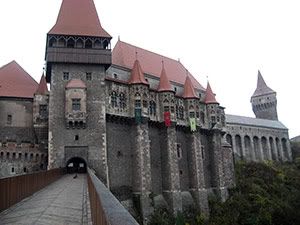
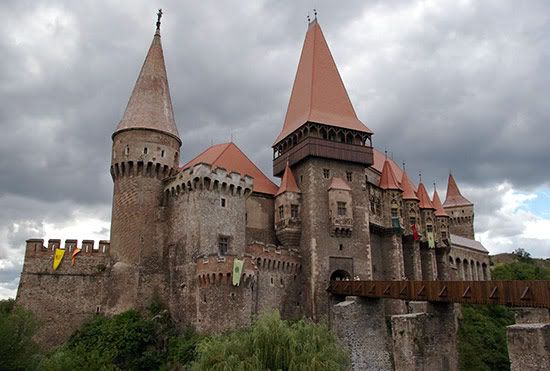
Built in the 14th century, Corvinilor Castle represents one of the most amazing and well-preserved medieval buildings, being in fact the most famous property of Iancu de Hunedoara, building that even today dominates the city of Hunedoara.
Iancu de Hunedoara was the one who stopped the Turkish army at Belgrad in their rise towards Europe, after conquering the Constantinople in 1456. Only a few know that even today the bells of the Catholic Churches still toll in the middle of the day for this victory, as a decision of the Vatican Church.
The Corvinilor Castle is one piece of a kind because of the special styles in which it was built and because of the presence of some military innovations. It is also known that people led a very impetuous life there at the castle for more than 400 years. This building suffered along the years various changes and during Iancu de Hunedoara’s reign, the castle became also a luxurious home, not only a strategic point.
The castle has 42 chambers, 2 platforms, 2 bridges and is built on an area of 7000 square m.


The access to the castle is made on a wooden bridge which is sustained by 4 massive stony piers that are placed in the riverbed of Zlasti, leaving behind the Hussan’s Court and the niche that shelters the statue of St. John de Nepomuk, the protector of bridges. From there you can see the new rectangular-shaped stony tower (Turnul nou de poarta) which is impressive by its great size. You can also visit the prison of the castle where Vlad Tepes was supposed to have been kept as prisoner. On the left side, just as you get out of the stony tower, you can see Loggia Matia at whose floor one can see the only secular fresco dating the Renaissance and also The Golden Chamber where one can see “Items of the collection of the museum from the Corvinilor Castle”. At first, the museum exhibitions focused only on the Middle Ages items, but in short time, these approached other fields, such as archaeology, ethnography, decorative art and ancient books.
At the first level of the New Gate Tower, you can find the “Princesses’ Living Room” (Camera Domnitelor) where you can see pieces of furniture belonging to the 19th century: a table, a sideboard and a cupboard. Across the spiral staircase, one reaches the Council Hall (Sala Dietei), which is built in late gothic style. At the exit, the staircase leads to the floor where the Capistrano Tower is situated. To the right there is another staircase that leads to the second level of the Southern Palace, to the rooms that were used in the 18th century as offices for the iron mines Administration of Poiana Rusca Mountains.


In the yard, near the well, one can also visit the artillery platform, which was neatly rearranged in the 19th century. From there you have a pleasant view over the Bears’ Pit, the Northern Palace, the chapel and the courtyard of fountain.

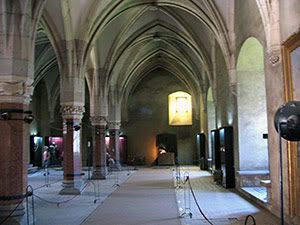
The last sight, the Knights Hall (Sala Cavalerilor), one of the most interesting laic spaces in 15th century Transylvania, is situated in the Western side of the castle, at the ground floor of the Great Palace. It is divided into two sectors by a row of octagonal columns. This hall served as dinning room for festive occasions or as judgment and council room for noblemen, after the German model.


“You have water, but you have no soul”

In the vicinity of the entrance of the church, there is a fountain which was dug in stone by three Turkish prisoners. The legend says that when these three prisoners were captured by Iancu de Hunedoara from his battles against the Turkish army, they were told that if they dug in stone and reached for water, they would be released. For ten years the Turkish prisoners dug nearly 20-25 meters into stone and they finally reached for water, but instead of being released, they were beheaded. This is just a legend and it’s not specific only to Corvinilor Castle. Before being executed, it is said that one of the prisoners had carved into stone the following words: “You have water, but you have no soul”. The truth is that one of the prisoners, which was in fact the son of a vizier, carved on one of the stones from the wall near the well that he built that well together with two other prisoners while they were prisoners to these giaours.

Saturday, May 2, 2009

Women’s Cave


Among the thousands of caves in the Carpathians Mountains, only a few had such a rich past in events as the Woman Cave (Pestera Muierii) from Baia de Fier had. Situated in a wild place, having more than just one entrance, the Woman Cave was a natural fortress, a resistance point for the inhabitants of the neighboring settlements over their struggling history. One of the entrances offers an excellent observation point over the field from the South and another entrance opens the view to the dense forests of the Parang Mountains.

The electrification established between 1963 and 1978 changed the cave in the most popular and visited speleological objective from Romania. Even if, what the dimension, the beauty and the quality of the arrangement are concerned nowadays, the Woman Cave, with an aggregate length of galleries of over 3,500 m, was surpassed long time ago, it continues to be the headline of the Romanian speleotourism, being visited by thousands of visitors every year. Situated nearby, but at higher levels of karsti-fication, are also other caves of smaller dimensions, such as the Corbului Cave, Parcalabului Cave and Iedului Cave known under the name of the Baia de Fier Caverns.

It seems that the first written record about the Woman Cave dates back to 1870, when the archaeological Al. Odobescu mentioned it in an archaeological questionnaire. Since then, in over 100 years of researches, an important and varied scientific and documentary material has been collected , attesting to valuable archaeological, paleonthological, geomorphologic, as well as biospelaeological and mineralogical finds. These form together over 95 % of the 3,566 m aggregate length of the cave galleries. For practical reason and because of the superposed location of the galleries, we call them the upper and lower storey. The general north-south orientation of the whole system of galleries runs along the fissure which allowed the waters of the Galbenul River stream to dig them in the rocks. You may enter the cave through three different points, a northern, eastern and southern mouth. The last two entrances are the places of resurgence of the waters of the former underground stream which once flowed through the northern slope. Nowadays the Galbenul stream has abandoned its underground course and the karstification process is continued only by the percolation waters provided by rainfalls or snow melts.

On entering the cave through its northern gate, at about 130 m within you find yourself in front of the Small Dome-shaped stalagmite from which widens on your left the Altar Chamber, rich in concretions with a ceiling ending in a 17 m high swallow hole. Walking in the same direction, a gallery with numerous boulders lying on the floor leads to the eastern mouth, called the Altar Gate, which opens into the abrupt slope of the Galbenul Gorge. The main gallery, known as the Electrically-lit Gallery, continues southwards and gets more and more spectacular because of its numerous ceiling concretions and basins, sometimes filled with water, in the portions, called the Small Basins and the Large Basins. Two hundred and seventy meters farther you enter the Turk’s Chamber, one of the most beautiful parts of the upper floor. Huge stalagmites, domes, wall and ceiling concretions taking the strangest shapes are known as Father Christmas, the Turk, the Turk’s wife, etc.

Passing through a narrow corridor and over a threshold by climbing a metal ladder, you enter the so-called Chamber of Wonders, because of its numerous microbasins and candle-shaped stalactites and stalagmites, which adorn it. On coming back to the main gallery you will walk on through the Small Gate, a portion where the walls and ceiling draw very near, leaving only a small passage and you will enter the Guano Chamber. On the eastern wall make out a whole network of galleries, a real place of refuge for the cave fauna, since it is less accessible to visitors, and not yet electrified. From the Guano Chamber on there is only a 40 m’ s distance to daylight, passing through the southern gate, which opens, into the slope facing the largely terraced meadow. The lower floor, divided into two sectors by alluvial silting, is of particular scientific interest. For this reason it was declared Speleological Reserve in 1955 and the Woman Cave, aMonument of Natural Reserve.

The northern sector, made up of a network of labyrinthine galleries totals a length of 1,650 m. you may enter it through a narrow connecting gallery, opened in the western slope of the upper floor at about 30 m within from the northern entrance. After crawling along a short portion and going down a 2 m deep step you reach a small chamber from whose north-western corner an 18 m deep swallow-hole takes you to the Electrician’s Gallery. It is rather difficult to describe this sector of the cave owing to the cross-connexions of its galleries. Nevertheless you may make out a western system with the Electrician’s Gallery as a main chamber, and an eastern system with the Excentric’s and Basin Galleries as principal rooms. They are characterized by a high degree of alluvial silting and the presence of potholes of different depths varying between 10 and 15 m, as well as an exceptional variety of concretions. They reach a climax in the Red Chamber of daylight, a rare mineral species found in caves, made up of calcium phosphocarbonate and taking all the known shapes in calcite: stalagmites, stalactites, curtains, wall and floor concretions, rimstone pools, etc.


The Bears’ Gallery was named thus because of its numerous skeleton remains of the Quaternary fossils of mamalia, belonging mostly to cave bears. Its great variety and numerous calcite concretions make it quite remarkable. Its walls are also adorned with corrosion hieroglyphs, leopard skins, wall plates and spoons. The Pearl Chamber has a low ceiling, in some places under I’m, and displays a lovely folded curtain right at its entrance, known as the Bride’s Veil. The floor looks mosaic-shaped on account of its many crystals and contains numerous cave pearls. If, instead of going down the first metal ladder towards the southern sector, you would go left and climb a 2.5 m-high step, you would reach the so-called Mousterian Gallery. It is the place where archaeologists found evidence that the cave was inhabited by man in Middle and Higher Paleolithic times.

Legend


There are two legends related to the name of the Woman Cave:
The first one says that, long time ago, when men used to dominate everything and to go defend the land against the invaders, women used to take in haste the children and old people into the cave , which was know at that time only them (women). There they used to stay until the battles were over. The second version says that this name-the Woman Cave would derive from the fact that in the days dominated by draught in summer, the women used to sit in front of the mouth of the cave and spin the wool. The air that came out of the cave used to facilitate the work of spinning the thread. Others affirm that the women used to even go inside the cave, where they used to melt the flax and the hemp.

Monday, April 13, 2009

The Legend of Omul Mountain


The legend tells us about Emanuil, son of a mighty king and of his extraordinary queen. This queen, Emanuil’s mother, was a strange person: she had the healing gift and with only one touch she could relieve the pain and sufferance of people. People from all over the place came to her to be cured of any physical or spiritual distress they might have.
The Queen's Exile and Death
Unfortunately this much beloved queen had enemies, mean people who wanted her cast out of the castle and after a while they really managed to persuade the king to banish her from the palace.The queen was very sad and although she was in exile she continued to cure ill people. After a while she died of sorrow. Emanuil was the most affected although he was not allowed to see much of his mother during the past years. He ran away from the court and no one knew where he had disappeared. The king was dark and surly as his own son and heir vanished like that and could not see any reason for Emanuil to do that.
The truth was that Emanuil was in deep sorrow after his dear mother and retreated to the mountains, to a mysterious eremite, an old friend of the queen. Emanuil cried and explained to the hermit how blue and lost he felt and begged him for advice and guidance to become a good person. After calming him down the wise hermit advised the lad to go back to the humans and serve them: if he wanted to be good he had to learn to be humble and to do good deeds without asking for anything else instead. The young man decided to go and do it exactly.
The first person he met on his way was an old lady who was carrying a heavy bunch of fire wood. Manuil offered to help her with the burden. He wanted to take farewell when they reached the woman’s cottage but she wanted at all costs to offer him a good meal, shelter for the night and pay him for the work done. The day after, before his leaving she made him a strange gift (probably the old woman was a sort of a witch): all the good or harm he would do to people to turn back to him.

Further on Emanuil found a man who has fallen from a rock and was badly injured. He took the man home and took care of him but in the end the man died, leaving behind a beautiful young daughter, Rada. The prince promised to the father to take care of the girl. After the man passed away Emanuil and Rada went up to the mountains where he left her to the hermit to be raises and tutored by the wise man, so she could become a good wife for the prince when she grew up.
The prince went back to the people where he continued to help the poor and needy. After a while he realized he wanted to do something more, to do something to improve himself, to become a literate and a wise man. He decided to study medicine and that is why the prince became apprentice to a chemist. With the money earned he paid his studies and became a good doctor. One day the hermit paid Emanuil an unexpected visit – he came to let the prince know that Rada found herself a fiancé in the valley and wanted to marry him. The young doctor lost his temper: he shouted at the hermit and pushed him so brutally that the old man lost his balance, fell, hit a rock and died.
Emanuil was inconsolable – he could not forgive himself for what he did and retreated far away on a mountain. He continued to cure people for free but became such a surly and unhappy man. No one knew his name and no one dared to ask so they called him simply “Omul” (the Man). He remained there for many years until one good day Rada and one of his old servants from the court appeared in the solitude of his cave. They prayed him to come back as his father was dead.
Rada explained Emanuil she was not married and that story was only a test of the hermit… the prince was left speechless but when people from all over who were helped or cured by him arrived to thank the prince, a smile appeared on his face after many years and he came back to the castle and made Rada his queen. They lived happily together and had many children. The mountain where the hermit and then Emanuil lived once was still called “Omul”.
True facts: Omul mountain is the highest peak of Bucegi chain. Its height is about 2505 meters and on top of it there is a weather station and a tourist chalet, which make Omul the highest spot of Romania to be permanently inhabited.

Saturday, April 11, 2009

Lake Sfanta Ana


Situated in the mount Ciumatul Mare, on the left side of the river Olt, the lake Sfanta Ana rises on the bottom of an inactive volcano, named Ciomatu. The lake water is almost as pure as that of distilled water. You cannot find one living creature in the water, because of the lack of oxygen.

The legend

Any beautiful place has a legend, this one has two. One of the legends says that once upon a time, a young couple was supposed to get married. The young girl, by her name Ana, who was about to get married, did not agreed with the marriage because her parents forced her to grab the young man’s fortune.
She could not bear the thought of getting married with that rude boy whom she did not love. In the night of the wedding, the bride ran away and threw herself in the lake. Her body was never found. This is why, the locals named the lake Sfanta Ana( Saint Anne).
Another legend says that, in the old times, in this places lived two tyrants which were brothers. One of them mastered a fortress on the top Puciosul and the other one a fortress situated on the place of the actual lake. The master of the fortress from the top Puciosu had a great carriage , fact that enraged hid brother and promised that he will come the next day with a greater carriage. To gain the promise, he harnessed eight of the most beautiful girls from the surrounding places. The beautiful girls could not move an inch the heavy carriage.
The tyrant begun the to beat and whip the girls. One of the girls, named Ana, damned the evil master, and out of the blue begun a terrible storm, with thunders and lightning, and the fortress along with its master, was covered by fames. In the place were the fortress appeared a lake, and the locals named it Sfanta Ana.

This are the legends, this is the place. A big beautiful blue lake on top of the mountain, a small cottage by the lake, providing you food and drinking, and the freedom to imagine. A road that circles the lake, separating it from the woods, will offer you a peaceful walk. If you are not in the mood for socializing, and just want to admire nature’s miracles and beauties, take the road and keep walking. Most surely you will find a place of your own.
If you are a lazy walker, and wish for easy mountain likes, this is the perfect spot for you. Easy access, short hikes, beautiful landscapes, and the refreshing and conforting powers of water given to you by the beautiful lake. Romantic sunsets, relaxing times…The places is so beautiful it will give life to the artist within you.
If you can’t make your mind between choosing the mountain or the sea, you can choose the Sfanta Ana lake. With maximum 7 meters depth, bathing is allowed. Daydreaming is suggested.
If you are searching for a place to relax, to find your inner self, to run away from the city life, the stress at your office, your boss, capitalism, crashing cars, noisy parks, rude waiters, malls, everything that eats a part of you and loose yourself in this ocean called life, this is the perfect place for you my friend. Take a vacation, you will become a new man!
Once you are here, you do not need to see the weather broadcast, the locals can tell how the weather will be. Two fissures formed in the mountain help them tell how the weather will be. The locals know that if the emanations are strong, it’s a sign that it will be a storm, if not, it will be a beautiful sunny day.
The phenomenon is due to the fact that inside the mountain there is still a powerful volcanic activity, sensible to any change of the atmosphere.Mountain, lake, lake, sunbaths, peace, weather tellers, legends…want more? Go discover on your own!

Wednesday, April 8, 2009

ARGES MONASTERY


The Episcopal Church, or the Monastery of Curtea de Arges, was founded by prince Neagoe Basarab between 1514-1517, on the site of a metropolitan church which had been raised in the 14th century and acknowledged by the Archbishopric of Constantinople in 1359.The legend has it that one day, a very wealthy and religious Wallachian prince, the Black Prince, rode with nine masons and their master Manole to find a place and build a church more beautiful than anyone may have seen before. The masons started to work, but whenever they reached to the top, the walls would colapse before they could ever finish it. They decided that the first human being they would lay their eyes upon was to be sacrificed in order to see their work done. And it so happened the Manole 's wife showed up to bring her husband's lunch, so that he had to keep his vow and immure his own wife alive within the church walls. The place of this immolation can still be seen between two walls of the southern front side of the church. This is how the monastery could be finished, and the prince was pleased to find that it was as beautiful as it could be. But the prince would not want Manole to build another church that could match his own. So he ordered the scaffolding removed, which left Manole stranded on the roof. In an attempt to escape, Manole made himself a pair of wings from shingles, but they were of no avail, and he would crash to the ground like Icarus and die. Upon his crash, on that very spot, a spring would gush forth, which is now called Manole's well. Today people would throw coins in its basin, to make their wishes come true.
Indeed Neagoe Basarab (1512-1521) would be known in history as the Black Prince, and it is a real fact that the church master builder's name whom he had brought from Nicosia was Manole. Again it is no less true that the prince himself supervised the construction of the monastery all the way, from the beginning to the end. The church one can see today is not Manole's original creation of 1517, but a recreation of 1875-1876 by the Frenchman Lecomte de Nouy, who grafted on all the pseudo-moorish accretions.
Like with so many other cultural sites of the world, at Curtea de Arges Monastery legend and truth intermingle and form up an inseparable whole, lending a special flavour to the flow of historic facts and figures.
The Monastery Curtea de Arges, built in Albesti stone along with marble and mosaic brought from Constantinople by Neagoe Basarab (1512-1521), has the classical harmonious aspect of an Orthodox church: the pronaos (also a necropolis), the nave and the altar have a peculiar architecture and rich ornaments: a boxy structure enlivened by whorls, rosettes and fancy trimmings rise into two octogonal belfries, each having eight narrow windows frames, each festooned with little spheres and the three armed cross of Orthodoxy. The roofs of the four belfries seem to have been made by a goldsmith, whereas the chains which support the crosses seem to be large pieces of jewelry.
A belt carved in stone as a rope twisted in four goes all around the church dividing its exterior walls into two sides, namely the lower side, decorated with rectangular tall panels framed in carved stone, with narrow windows, and the upper side, with a range of largely opened arches which encircle the church. The decorations of the disks which link the arches have Arabian, Persian and Georgian motifs, in green, in blue and golden colours.
Prince Neagoe Basarab died before he saw his "temple" finished. His son-in-law Radu from Afumati (1522-1529) took over and brought Dobromir of Targoviste to paint the interior walls (1526). Unfortunately, the paintings restored in 1875 by Emile Lecomte de Nouy's brother are inferior to the original ones. Fragments of the genuine frescoes made by Dobromir can still be seen at the Art Museum and at the National Museum of History in Bucharest.
Along time, the church was successively damaged by wars, plundering, earthquakes, fires and was restored during the rules of Princes Matei Basarab (1632-1654), Serban Cantacuzino (1678-1688) and Bishop Iosif Sevastis at the end of the 18th century.
Whatever the patrons and artists who designed this church, it remains impressive by its votive paintings, by its marble gilted bronze, by its onyx iconostasis, by its twelve columns with floral ornaments representing the twelve apostles. In the pronaos there are the tombs of its founders, Neagoe Basarab and Radu from Afumati, as well as of the first couples of Romanian kings and queens (Carol I and Elisabeta, Ferdinand and Maria) which render this church not only a princely, but also a royal necropolis, alongside a splendid monument of Romanian art and history.
The white marble tombstones of Carol 1 (1839-1914) and his poet wife Elizabeth 1853-1916) lie on the right in the monastery`s pronaos (entrance hall). On the left of the entrance are the tombstones of King Ferdinand 1(1856-1927) and the British-born Queen Marie (1875-1938) whose heart, upon her request, was put in a gold casket and buried in her favourite palace in Balcic in southern Dobrogea. Folowing the ceding of southern Dobrogea to Bulgaria in 1940, however, her heart was moved to a marble tomb in Bran. Neagoe Basarab and his wife Stina are also buried in the pronaos.
In the park opposite lies the legendary Manole`s Well (Fintina lui Manole). Legend has it that Manole tried - and failed - to fly from the monastery roof when his master Neagoe, removed the scaffolding to prevent him building a more beautiful structure for anyone else. The natural spring marks his supossed landing pad.
The Old Princely ChurchThe saint patron of the chapel is "The Saint & Martyr Filofteia" who has been protecting the monastery for 8 centuries and whose relics are inside the Episcopal Cathedral. In 1517, the canonization of Saint & Hierarch Nifon, The Patriarch of Constantinopole, the Metropolitan of Wallahia took place here.
This is also the place where the relics of the Saint Nifon are preserved in a coffin made of silver and plated with gold. The Saint’s head and hands represent a present got by Neagoe Basarab from the monks who live in The Athos Mountains. There is also a coffin with the relics of the Saint Serghie, Vach and Saint Martyr Tatiana.


Blog Widget by LinkWithin
ROMANIA © 2008 Por *Templates para Você*