Showing posts with label visit. Show all posts

Tuesday, May 5, 2009

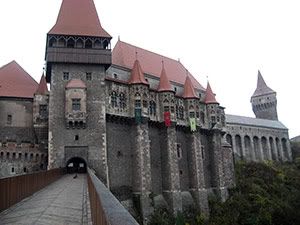
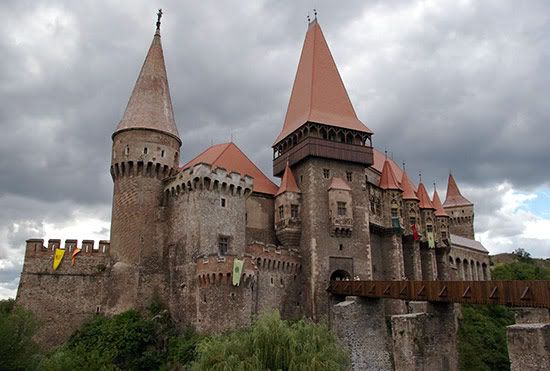
Corvinilor Castle


Built in the 14th century, Corvinilor Castle represents one of the most amazing and well-preserved medieval buildings, being in fact the most famous property of Iancu de Hunedoara, building that even today dominates the city of Hunedoara.
Iancu de Hunedoara was the one who stopped the Turkish army at Belgrad in their rise towards Europe, after conquering the Constantinople in 1456. Only a few know that even today the bells of the Catholic Churches still toll in the middle of the day for this victory, as a decision of the Vatican Church.
The Corvinilor Castle is one piece of a kind because of the special styles in which it was built and because of the presence of some military innovations. It is also known that people led a very impetuous life there at the castle for more than 400 years. This building suffered along the years various changes and during Iancu de Hunedoara’s reign, the castle became also a luxurious home, not only a strategic point.
The castle has 42 chambers, 2 platforms, 2 bridges and is built on an area of 7000 square m.


The access to the castle is made on a wooden bridge which is sustained by 4 massive stony piers that are placed in the riverbed of Zlasti, leaving behind the Hussan’s Court and the niche that shelters the statue of St. John de Nepomuk, the protector of bridges. From there you can see the new rectangular-shaped stony tower (Turnul nou de poarta) which is impressive by its great size. You can also visit the prison of the castle where Vlad Tepes was supposed to have been kept as prisoner. On the left side, just as you get out of the stony tower, you can see Loggia Matia at whose floor one can see the only secular fresco dating the Renaissance and also The Golden Chamber where one can see “Items of the collection of the museum from the Corvinilor Castle”. At first, the museum exhibitions focused only on the Middle Ages items, but in short time, these approached other fields, such as archaeology, ethnography, decorative art and ancient books.
At the first level of the New Gate Tower, you can find the “Princesses’ Living Room” (Camera Domnitelor) where you can see pieces of furniture belonging to the 19th century: a table, a sideboard and a cupboard. Across the spiral staircase, one reaches the Council Hall (Sala Dietei), which is built in late gothic style. At the exit, the staircase leads to the floor where the Capistrano Tower is situated. To the right there is another staircase that leads to the second level of the Southern Palace, to the rooms that were used in the 18th century as offices for the iron mines Administration of Poiana Rusca Mountains.


In the yard, near the well, one can also visit the artillery platform, which was neatly rearranged in the 19th century. From there you have a pleasant view over the Bears’ Pit, the Northern Palace, the chapel and the courtyard of fountain.

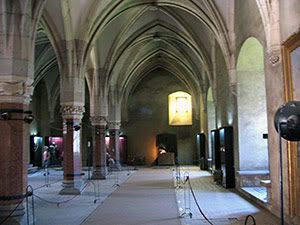
The last sight, the Knights Hall (Sala Cavalerilor), one of the most interesting laic spaces in 15th century Transylvania, is situated in the Western side of the castle, at the ground floor of the Great Palace. It is divided into two sectors by a row of octagonal columns. This hall served as dinning room for festive occasions or as judgment and council room for noblemen, after the German model.


“You have water, but you have no soul”

In the vicinity of the entrance of the church, there is a fountain which was dug in stone by three Turkish prisoners. The legend says that when these three prisoners were captured by Iancu de Hunedoara from his battles against the Turkish army, they were told that if they dug in stone and reached for water, they would be released. For ten years the Turkish prisoners dug nearly 20-25 meters into stone and they finally reached for water, but instead of being released, they were beheaded. This is just a legend and it’s not specific only to Corvinilor Castle. Before being executed, it is said that one of the prisoners had carved into stone the following words: “You have water, but you have no soul”. The truth is that one of the prisoners, which was in fact the son of a vizier, carved on one of the stones from the wall near the well that he built that well together with two other prisoners while they were prisoners to these giaours.
Wednesday, April 22, 2009

Black Church-Brasov


Brasov’s strategic geographical position, close to the commercial route Rucar – Bran, through the Carpathian Mountains, has influenced the economic development of the city. Thanks to its nearness to Bucegi Mountains and the Bran Castle, Brasov is one of the most important destinations in Romania.

The Black Church is the heart of Brasov
Over 500 years old, Biserica Neagra (the Black Church) is the most representative historic monument in Brasov, the greatest Gothic church in Transylvania and, in some historians’ point of view, the greatest religious edifice from Vienna to Istanbul. More than that, inside the church there is one of the greatest organs in Europe, and also the largest collection of old carpets from Asia Minor. The construction of this Gothic Evangelic church began around 1380, in the time of Vicar Thomas Sander, and initially it was named Saint Mary’s Church.

In 1421 an important part of the construction was destroyed during the Turkish invasion, and that is why the church was completely built in 1477. Nowadays it is considered the greatest place of worship in Romania, with impressive dimensions: 90 meters in length, between 25 and 37 meters wide, 65 meters from the floor level to the highest point of its Cross tower, while it can house about 5000 people. More than that, the biggest bell in the country, weighting 6.3 tones, is to be found in its tower as well.

Then, after almost 200 years, a fire partially destroyed it in 1689, and the smoke blackened the walls, and for a long period of time the façade couldn’t be renovated. The restoration lasted about 100 years, but the place of worship was called Biserica Neagra (the Black Church) because of its black smoked walls (Die Schwarze Kirche in German and Fekete Templom in Hungarian). The present roof, 20 meters in height, was also built after this fire. The workers who restored it were from Danzing, and this is the reason why the new vaults are in Baroque style and not in Gothic.

Black Church’s organ
The Black Church’s organ, with 4000 pipes and considered one of the biggest in Europe, was built between 1836 and 1839 by the Berlin organ maker Buchholz, and it is famous for its sonority. In 1924 the gallery in front of the organ was enlarged in order to organize sacred music concerts with chorus’ participation. Many vinyl discs, audio tapes and CDs were made in the course of years.
Nowadays an organ concert is organized every week.

Priceless Values
The collection of old carpets from Brussa, Usak and Ghiordes regions in Asia Minor, dating from the 17th and 18th centuries represent an invaluable thesaurus of the Black Church. Those were donated in the course of years by the craftsmen, merchants and citizens of the city.
The furniture and worship objects represent other remarkable values that turn this construction into a place that no tourist can miss. For instance, the bronze font made by the local craftsmen was donated in 1472 by Vicar Johannes Reudel. After almost 150 years, in 1716, blacksmith Meensen Hannes made a wonderful wrought iron grating that surrounds the font. Then, in the South porch there is a mural painting made after 1476 that shows Virgin Mary and Child Jesus, featured between Saint Catherine and Saint Barbara. The crests of Matthias Corvinus and his wife Beatrice of Naples – Aragon are at the bottom of the painting.
Three folds, with five paintings from the Feldioara altar (the end of the 15th century) are also to be mentioned. The pews in the naos date from the end of the 17th century and the first half of the 18th century and have Baroque wooden carved ornaments. Then the lecterns are in neo - gothic style, dating from 1866, and the pews in the centre of the naos, made of oak wood, were placed there in 1937.

The old tombstones of some famous personalities of the city were built in the side spaces of the West entrance when the neo - gothic altar was built (in 1866) and when the heating system was installed (in 1937).
An oiled canvas representing “The Wedding From Cana (Nunta din Cana)“, work of Hans Eder painter, it is exposed on the frontal wall of the northern lateral nave.
Hans Elder’s oil painting showing “The Wedding at Cana” is exhibited on the frontal wall of the North side naos. The emblem of the city, representing a crown on a rooted trunk, is plotted in relief on the pillar in front of the pulpit.
Inside the church there are also some sculptures, the oldest of all being the bust of Saint John the Baptist. The others represent Saint Thomas, Saint Jacob the Pilgrim, Jesus Salvator Mundi, Virgin Mary, Saints Pavel, Luke and Sebastian.

A sculpture uncommon for a place of worship is to be found on the North buttress. It is about the representation of a child that seems to be about to fall. The legend says that when they were building the church, one of the workers became jealous of a very talented apprentice. At one point he asked the child to lift something from the cornice, and when he leant out, the worker pushed him. The legend also states that the sculpture was made by the other workers to the memory of the cowardly killed child.

In the course of time, Biserica Neagra (the Black Church) endured several maintenance and restoration works. Between 1937 and 1944 the sculptures from the exterior buttresses were replaced with copies, and the originals were sheltered inside the church. Between 1967 and 1977 the money for renovation was from the public budget, and the restoration after the earthquake in 1977 was made with money from donations and subscriptions.

Tourist potential
After the touristic estimations, about 100 000 persons visit Biserica Neagra (the Black Church) every year, being considered the second major attraction in the county, after The Bran Castle. The visiting program is daily between 10 a.m. and 5 p.m., and the price of a ticket is 4 lei for adults and 2 lei for students, pupils and pensioners. At the entrance there are points of sale with postcards with the whole church and with details of it. Taking photos and making films are forbidden. One can easily find accommodation units in the vicinity of the church, in hotels and boarding houses.

Blog Widget by LinkWithin
ROMANIA © 2008 Por *Templates para Você*