Showing posts with label castle. Show all posts
Tuesday, May 5, 2009
Corvinilor Castle
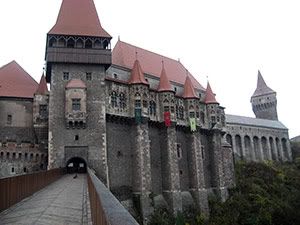
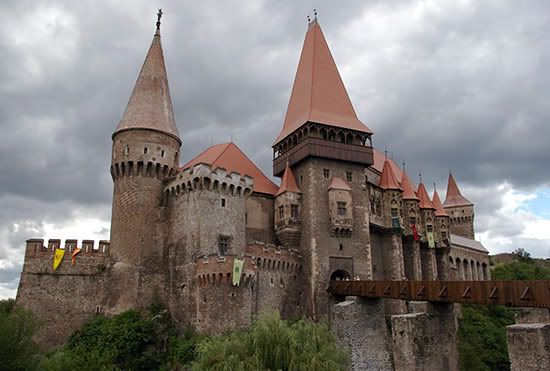
Built in the 14th century, Corvinilor Castle represents one of the most amazing and well-preserved medieval buildings, being in fact the most famous property of Iancu de Hunedoara, building that even today dominates the city of Hunedoara.
Iancu de Hunedoara was the one who stopped the Turkish army at Belgrad in their rise towards Europe, after conquering the Constantinople in 1456. Only a few know that even today the bells of the Catholic Churches still toll in the middle of the day for this victory, as a decision of the Vatican Church.
The Corvinilor Castle is one piece of a kind because of the special styles in which it was built and because of the presence of some military innovations. It is also known that people led a very impetuous life there at the castle for more than 400 years. This building suffered along the years various changes and during Iancu de Hunedoara’s reign, the castle became also a luxurious home, not only a strategic point.
The castle has 42 chambers, 2 platforms, 2 bridges and is built on an area of 7000 square m.
The access to the castle is made on a wooden bridge which is sustained by 4 massive stony piers that are placed in the riverbed of Zlasti, leaving behind the Hussan’s Court and the niche that shelters the statue of St. John de Nepomuk, the protector of bridges. From there you can see the new rectangular-shaped stony tower (Turnul nou de poarta) which is impressive by its great size. You can also visit the prison of the castle where Vlad Tepes was supposed to have been kept as prisoner. On the left side, just as you get out of the stony tower, you can see Loggia Matia at whose floor one can see the only secular fresco dating the Renaissance and also The Golden Chamber where one can see “Items of the collection of the museum from the Corvinilor Castle”. At first, the museum exhibitions focused only on the Middle Ages items, but in short time, these approached other fields, such as archaeology, ethnography, decorative art and ancient books.
At the first level of the New Gate Tower, you can find the “Princesses’ Living Room” (Camera Domnitelor) where you can see pieces of furniture belonging to the 19th century: a table, a sideboard and a cupboard. Across the spiral staircase, one reaches the Council Hall (Sala Dietei), which is built in late gothic style. At the exit, the staircase leads to the floor where the Capistrano Tower is situated. To the right there is another staircase that leads to the second level of the Southern Palace, to the rooms that were used in the 18th century as offices for the iron mines Administration of Poiana Rusca Mountains.
In the yard, near the well, one can also visit the artillery platform, which was neatly rearranged in the 19th century. From there you have a pleasant view over the Bears’ Pit, the Northern Palace, the chapel and the courtyard of fountain.
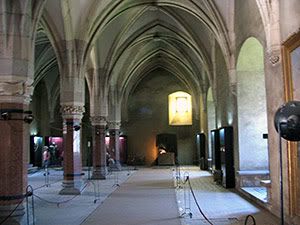
The last sight, the Knights Hall (Sala Cavalerilor), one of the most interesting laic spaces in 15th century Transylvania, is situated in the Western side of the castle, at the ground floor of the Great Palace. It is divided into two sectors by a row of octagonal columns. This hall served as dinning room for festive occasions or as judgment and council room for noblemen, after the German model.
“You have water, but you have no soul”
In the vicinity of the entrance of the church, there is a fountain which was dug in stone by three Turkish prisoners. The legend says that when these three prisoners were captured by Iancu de Hunedoara from his battles against the Turkish army, they were told that if they dug in stone and reached for water, they would be released. For ten years the Turkish prisoners dug nearly 20-25 meters into stone and they finally reached for water, but instead of being released, they were beheaded. This is just a legend and it’s not specific only to Corvinilor Castle. Before being executed, it is said that one of the prisoners had carved into stone the following words: “You have water, but you have no soul”. The truth is that one of the prisoners, which was in fact the son of a vizier, carved on one of the stones from the wall near the well that he built that well together with two other prisoners while they were prisoners to these giaours.
Labels: beautiful romania, castle, corvinilor castle, landscapes, legends, Romania, travel, visit
Monday, April 13, 2009
The Legend of Omul Mountain
The legend tells us about Emanuil, son of a mighty king and of his extraordinary queen. This queen, Emanuil’s mother, was a strange person: she had the healing gift and with only one touch she could relieve the pain and sufferance of people. People from all over the place came to her to be cured of any physical or spiritual distress they might have.
The Queen's Exile and Death
Unfortunately this much beloved queen had enemies, mean people who wanted her cast out of the castle and after a while they really managed to persuade the king to banish her from the palace.The queen was very sad and although she was in exile she continued to cure ill people. After a while she died of sorrow. Emanuil was the most affected although he was not allowed to see much of his mother during the past years. He ran away from the court and no one knew where he had disappeared. The king was dark and surly as his own son and heir vanished like that and could not see any reason for Emanuil to do that.
The truth was that Emanuil was in deep sorrow after his dear mother and retreated to the mountains, to a mysterious eremite, an old friend of the queen. Emanuil cried and explained to the hermit how blue and lost he felt and begged him for advice and guidance to become a good person. After calming him down the wise hermit advised the lad to go back to the humans and serve them: if he wanted to be good he had to learn to be humble and to do good deeds without asking for anything else instead. The young man decided to go and do it exactly.
The first person he met on his way was an old lady who was carrying a heavy bunch of fire wood. Manuil offered to help her with the burden. He wanted to take farewell when they reached the woman’s cottage but she wanted at all costs to offer him a good meal, shelter for the night and pay him for the work done. The day after, before his leaving she made him a strange gift (probably the old woman was a sort of a witch): all the good or harm he would do to people to turn back to him.
The Queen's Exile and Death
Unfortunately this much beloved queen had enemies, mean people who wanted her cast out of the castle and after a while they really managed to persuade the king to banish her from the palace.The queen was very sad and although she was in exile she continued to cure ill people. After a while she died of sorrow. Emanuil was the most affected although he was not allowed to see much of his mother during the past years. He ran away from the court and no one knew where he had disappeared. The king was dark and surly as his own son and heir vanished like that and could not see any reason for Emanuil to do that.
The truth was that Emanuil was in deep sorrow after his dear mother and retreated to the mountains, to a mysterious eremite, an old friend of the queen. Emanuil cried and explained to the hermit how blue and lost he felt and begged him for advice and guidance to become a good person. After calming him down the wise hermit advised the lad to go back to the humans and serve them: if he wanted to be good he had to learn to be humble and to do good deeds without asking for anything else instead. The young man decided to go and do it exactly.
The first person he met on his way was an old lady who was carrying a heavy bunch of fire wood. Manuil offered to help her with the burden. He wanted to take farewell when they reached the woman’s cottage but she wanted at all costs to offer him a good meal, shelter for the night and pay him for the work done. The day after, before his leaving she made him a strange gift (probably the old woman was a sort of a witch): all the good or harm he would do to people to turn back to him.
Further on Emanuil found a man who has fallen from a rock and was badly injured. He took the man home and took care of him but in the end the man died, leaving behind a beautiful young daughter, Rada. The prince promised to the father to take care of the girl. After the man passed away Emanuil and Rada went up to the mountains where he left her to the hermit to be raises and tutored by the wise man, so she could become a good wife for the prince when she grew up.
The prince went back to the people where he continued to help the poor and needy. After a while he realized he wanted to do something more, to do something to improve himself, to become a literate and a wise man. He decided to study medicine and that is why the prince became apprentice to a chemist. With the money earned he paid his studies and became a good doctor. One day the hermit paid Emanuil an unexpected visit – he came to let the prince know that Rada found herself a fiancé in the valley and wanted to marry him. The young doctor lost his temper: he shouted at the hermit and pushed him so brutally that the old man lost his balance, fell, hit a rock and died.
Emanuil was inconsolable – he could not forgive himself for what he did and retreated far away on a mountain. He continued to cure people for free but became such a surly and unhappy man. No one knew his name and no one dared to ask so they called him simply “Omul” (the Man). He remained there for many years until one good day Rada and one of his old servants from the court appeared in the solitude of his cave. They prayed him to come back as his father was dead.
Rada explained Emanuil she was not married and that story was only a test of the hermit… the prince was left speechless but when people from all over who were helped or cured by him arrived to thank the prince, a smile appeared on his face after many years and he came back to the castle and made Rada his queen. They lived happily together and had many children. The mountain where the hermit and then Emanuil lived once was still called “Omul”.
True facts: Omul mountain is the highest peak of Bucegi chain. Its height is about 2505 meters and on top of it there is a weather station and a tourist chalet, which make Omul the highest spot of Romania to be permanently inhabited.
The prince went back to the people where he continued to help the poor and needy. After a while he realized he wanted to do something more, to do something to improve himself, to become a literate and a wise man. He decided to study medicine and that is why the prince became apprentice to a chemist. With the money earned he paid his studies and became a good doctor. One day the hermit paid Emanuil an unexpected visit – he came to let the prince know that Rada found herself a fiancé in the valley and wanted to marry him. The young doctor lost his temper: he shouted at the hermit and pushed him so brutally that the old man lost his balance, fell, hit a rock and died.
Emanuil was inconsolable – he could not forgive himself for what he did and retreated far away on a mountain. He continued to cure people for free but became such a surly and unhappy man. No one knew his name and no one dared to ask so they called him simply “Omul” (the Man). He remained there for many years until one good day Rada and one of his old servants from the court appeared in the solitude of his cave. They prayed him to come back as his father was dead.
Rada explained Emanuil she was not married and that story was only a test of the hermit… the prince was left speechless but when people from all over who were helped or cured by him arrived to thank the prince, a smile appeared on his face after many years and he came back to the castle and made Rada his queen. They lived happily together and had many children. The mountain where the hermit and then Emanuil lived once was still called “Omul”.
True facts: Omul mountain is the highest peak of Bucegi chain. Its height is about 2505 meters and on top of it there is a weather station and a tourist chalet, which make Omul the highest spot of Romania to be permanently inhabited.
Subscribe to:
Posts (Atom)
